Blog • Engineering
EngineeringClinical & Healthcare AI August 29, 2026 5 min read

Certified Domain Expertise in Healthcare AI: Building FDA-Ready Training Datasets

Why generalist labeling platforms fail on complex DICOM CT/MRI scans and how clinical consensus changes outcomes.
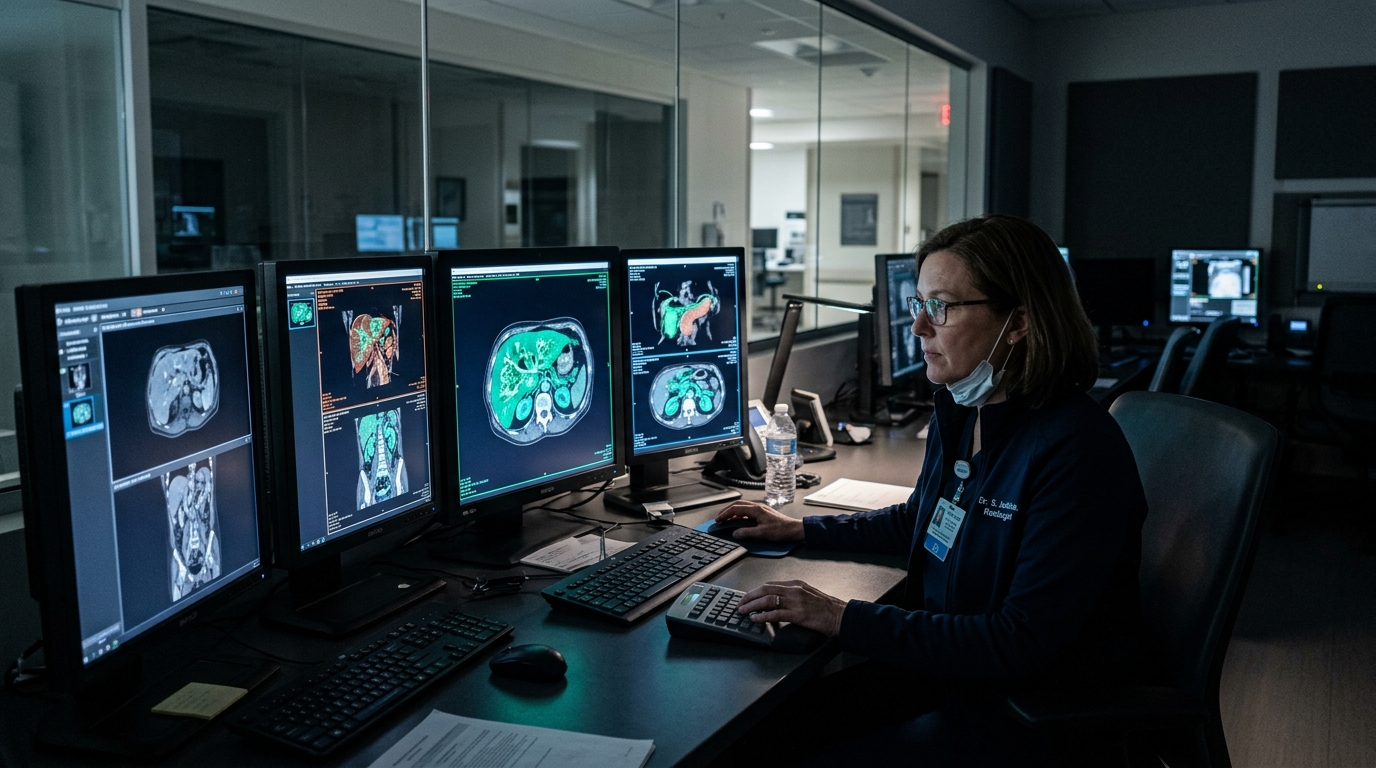
Certified Domain Expertise in Healthcare AI: Building FDA-Ready Training Datasets
Figure 1.0 • Primary Field Sensor Telemetry & Ground Truth
Author Profile
Dr. Robert Chen, MD

Dr. Robert Chen, MD

Clinical AI Director & Board Radiologist

Dual-board certified diagnostic radiologist overseeing clinical ground-truth protocols for frontier oncology models.

Engai Research Lab Verified
Executive Summary

In clinical medical imaging, a single mislabeled millimeter can dictate whether an algorithm correctly identifies early-stage malignant nodules or misclassifies harmless parenchymal scar tissue. Generalist annotation platforms fail because medical nuances require deep diagnostic training.

1. Beyond Generic Pixel Bounding
Axial CT and volumetric MRI scans operate in multi-planar space across hundreds of consecutive slices. Standard 2D bounding boxes destroy essential volumetric context. Radiologists must segment soft tissue boundaries with Hounsfield Unit windowing calibrated to specific tissue densities.
1. Beyond Generic Pixel Bounding
Figure 2.0 • Sensor Ingestion Topology & Multi-modal Calibration

2. Double-Blind Adjudication Protocol

Engai enforces a clinical protocol where two licensed radiologists independently segment volumetric lesions. An automated consensus algorithm flags any variance with Dice score below 0.92, automatically escalating the slice to a Senior Clinical Chair for definitive adjudication.
Conclusion visualization
Figure 3.0 • Production Adjudication Accuracy at Petabyte Scale

Summary & Engineering Outlook

This rigorous human-in-the-loop clinical workflow produces audit trails compliant with FDA 510(k) standards, enabling healthcare AI teams to advance from prototype to clinical trials 6 months faster.

Primary Research Sources & Empirical Citations

Google Scholar / Peer-Reviewed

This technical post combines live telemetry from Engai production fleets with the following verified academic literature, public dataset benchmarks, and Google Scholar references:

Technical StandardU.S. Food & Drug Administration (FDA)
FDA 510(k) Guidance for Machine Learning in Radiological Diagnosis

Clinical audit trail protocols and multi-reader double-blind adjudication standards.

Explore Source
Benchmark DatasetNational Cancer Institute / NIH
The Cancer Imaging Archive (TCIA) Volumetric Lung CT Benchmark

Reference volumetric DICOM scans and specialist consensus annotations for lung adenocarcinoma.

Explore Source

Continue Reading

How Active Learning Cuts 3D LiDAR Annotation Costs by 68% in Urban FleetsComputer Vision

How Active Learning Cuts 3D LiDAR Annotation Costs by 68% in Urban Fleets

Moving from brute-force random sampling to spatial uncertainty clustering in 128-beam autonomous perception pipelines.

6 min readRead
The Anatomy of Frontier Data: Why Vision-Language Models Require Spatial GroundingFoundation Models

The Anatomy of Frontier Data: Why Vision-Language Models Require Spatial Grounding

Eliminating multi-modal hallucinations through verified coordinate anchors and cross-attention supervision.

8 min readRead
Platform Architecture: Ingesting 50TB of Sensor Telemetry Per Day with Zero Latency BottlenecksPlatform

Platform Architecture: Ingesting 50TB of Sensor Telemetry Per Day with Zero Latency Bottlenecks

Building Engai’s fault-tolerant ingestion engine, streaming chunk verification, and automated schema conformance.

7 min readRead
Engai Resource Dispatch

Stay Ahead in Frontier AI Ground Truth.

Bi-weekly technical postmortems, empirical 3D perception benchmarks, and multimodal dataset releases delivered straight to your inbox.

• Read by 18,000+ ML engineers• Free open-access papers & datasets• No marketing spam, unsubscribe anytime